"You took a second cash advance to cover the first. Here's the stack."
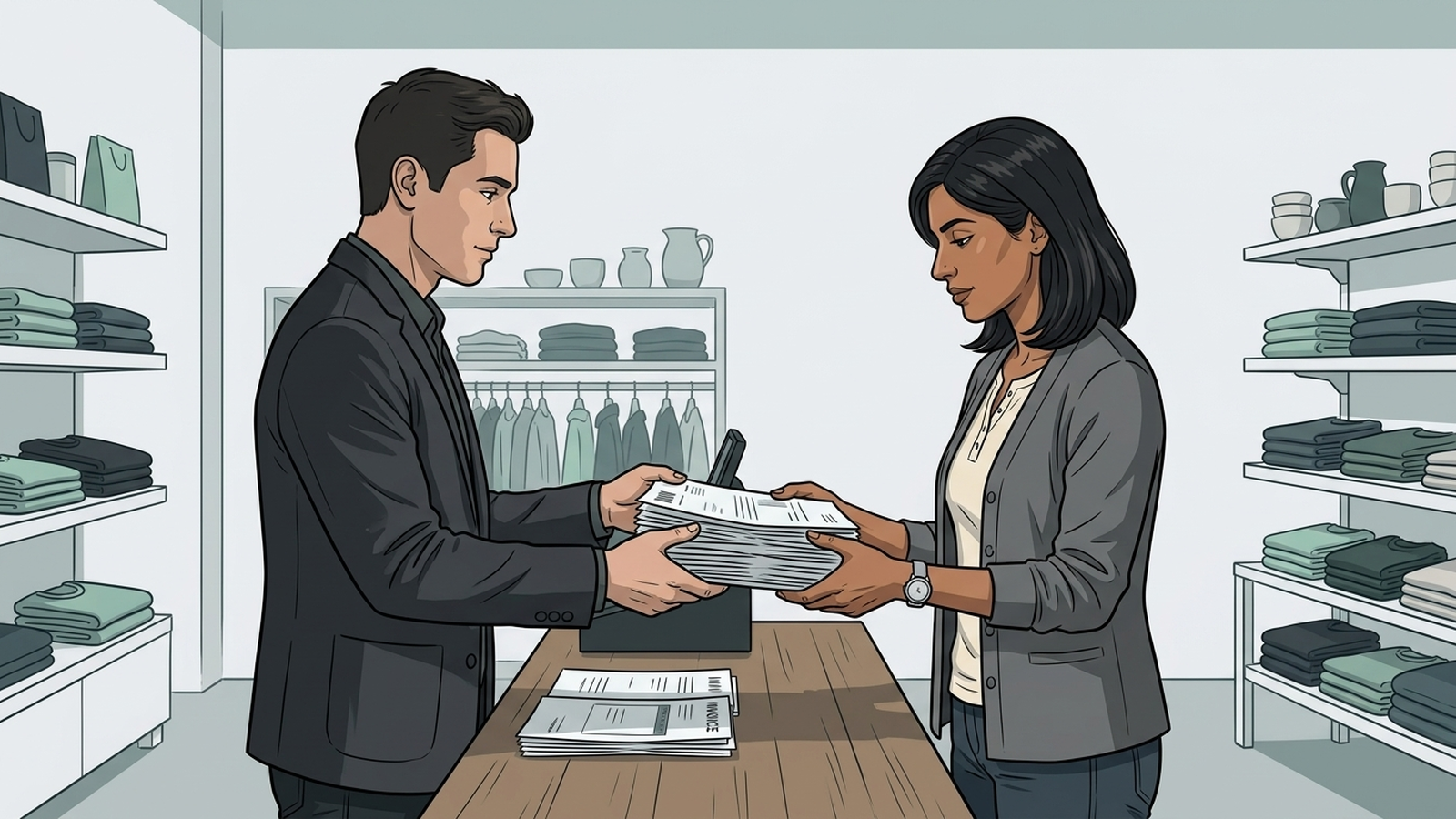
You took a second cash advance to cover payments on the first one. That is how a stack starts.
Nobody conned you. The first draw got tight against deposits, a renewal showed up at halfway, and the new money felt like relief. The cost of both advances is the number that usually stays off the offer sheet.
Month one: the first advance
Take the Quick Money Calculator defaults as of 2026-09-07, the same path the renew math uses on the site:
- Advance: $100,000
- Factor rate: 1.30
- Cadence: daily
- Term: 9 months
- Monthly revenue: $60,000
- Upfront fee: none
Payback is $100,000 × 1.30 = $130,000. Cost is $30,000.
About $688 leaves every business day. That is about $14,444 a month.
On $60,000 a month in revenue, the draw is about 24.1 percent of a month of revenue. Roughly seven days of every month's sales go to the payment before rent, payroll, inventory, or tax.
Measured the way a bank states interest, that path is about 73 percent a year. Said the simple way (cost over principal, stretched across the term), it is about 40 percent a year. The gap is the term: you pay the whole cost on money you hold for less than a year.
Month three: still more than half open
By month three, about $43,000 of the $130,000 payback is already out of the account. More than half is still sitting on the business.
The daily draw does not shrink because you are "ahead." On a factor product the total is fixed at the start. Paying faster clears the balance sooner. It does not cut the $30,000 cost the way interest does on a bank loan.
Month five: the renewal
Halfway is a common offer window. A new $100,000 advance shows up on the same terms. The balance still owed on the first advance comes out of the new money. Cash in hand is about $35,000.
That $35,000 is what you feel. The stack is what you miss:
- Charged the factor twice on about $65,000 you had not finished paying
- Across both advances you receive $135,000 in cash that reaches you
- Across both advances you pay $195,000
- Blended cost: $60,000
- Span: about 13.5 months
- Daily draw: still about 24 percent of a $60,000 revenue month
You did not get two clean $100,000 advances. You got $135,000 that reached the business and a $60,000 cost attached to it, while the same share of every month kept leaving.
Re-run the renew path anytime at zero2ten.biz/quick-money-calculator. Type the factor, term, and revenue on your own offer. The arithmetic is the same shape.
Why the second advance shows up
A merchant cash advance is a purchase of future sales, not a bank loan. It is priced with a factor rate, pulled daily or weekly, and paying early often does not discount the factor the way interest does.
Fast money is the right product for a short, self-liquidating need with a visible payoff: inventory for a confirmed order, a one-time gap with a known end. It is the wrong rung for payroll or an operating shortfall, because nothing makes you whole. The next month looks like this month. The draw keeps leaving. A second advance is how the business buys air.
The quick-money pitch you see after one search sells speed, size, and a skip-the-bank story. It almost never puts total payback next to the advance, the daily draw as a share of a normal month, or what a renew does to blended cost. Banks are cast as slow. The cost stays off the first screen.
Banks are not the enemy. A conventional loan or bank line takes 60 to 120 days when the file is ready because the product is different. Cheaper money asks for more due diligence: multi-year returns, matching documents, cash flow that covers the payment with cushion.
One hard exit rule: an SBA loan cannot pay off a merchant cash advance or a factoring agreement. If you are already in an advance, SBA is not the door out. Paying the advance down, consolidating into a non-SBA term loan with monthly payments, or waiting until the advance is clear are the paths that stay open.
What you control from here
If you are already in one advance, look at the stack math before a second one lands.
- Run your offer on the Quick Money Calculator. Use the renew path if halfway is on the table. Save the share of a month of revenue and the blended cost.
- Name the need out loud. Self-liquidating with a payoff date, or an operating hole with no end. The product fit follows that sentence.
- Complete the Lendability Check. Sixteen questions, free, no credit pull. The Banker shows his work on where the numbers land. "Not yet" is a valid result. It is still better than signing blind.
Know the cost and your numbers before the next offer sets them for you.
(Illustrative scenario. Inputs and outputs match the Quick Money Calculator site defaults and renew path as of 2026-09-07. Re-run with your own quote.)
Common questions
- What is a second advance stack on a merchant cash advance?
- A stack starts when a second merchant cash advance is taken while the first is still pulling from deposits. A common path is a renewal at the halfway point: a new advance on the same terms pays off the old balance, and you walk with the leftover cash. Across both advances you can receive less total cash than the headline amounts suggest and still pay the factor cost twice on part of the money.
- How much does a $100,000 merchant cash advance at a 1.3 factor cost?
- On the Quick Money Calculator defaults (daily draws, 9 months, no upfront fee), a $100,000 advance at a 1.3 factor has a $130,000 payback and a $30,000 cost. About $688 leaves every business day, or about $14,444 a month. On $60,000 a month in revenue, that draw is about 24.1 percent of a month of revenue. The true annual rate on that path is about 73 percent.
- What happens if I renew a merchant cash advance halfway through?
- At halfway on the $100,000 / 1.3 / 9-month path, about half the payback is still open. A new $100,000 advance pays the old balance out of the new money. Cash in hand is about $35,000. Across both advances you receive $135,000 and pay $195,000. The blended cost is $60,000 over about 13.5 months, and the daily draw stays near 24 percent of a $60,000 revenue month.
- Can an SBA loan pay off a merchant cash advance?
- No. An SBA loan cannot be used to pay off a merchant cash advance or a factoring agreement. If you are already in an advance, SBA is not the exit. Paying the advance down, consolidating into a non-SBA term loan with monthly payments, or waiting until the advance is clear are the paths that stay open.
- When is a merchant cash advance the right product?
- For a short, self-liquidating need with a visible payoff: inventory for a confirmed order, a one-time gap with a known end. It is the wrong rung for payroll or an ongoing operating shortfall, because nothing makes you whole and a second advance on top of the first stacks the daily draw against the same revenue.
Related reading
"Working capital loan cost: what the rate on the offer sheet means"
"A factor rate of 1.3 looks like 30%. Run the math and it's closer to 109% a year. Here's how to read what a working capital loan costs."
"What a merchant cash advance costs"
"A 1.3 factor rate on $40,000 is not 30 percent. Here is how to read the real yearly rate on a merchant cash advance before you sign."
"Why a profitable business gets declined for a bank loan"
"Making money doesn't guarantee a bank loan. Here's what lenders measure, and what you can fix before you apply."
"You applied for an SBA loan. You ended up with a cash advance."
"Nobody lied to you. The system sorted you downward in 72 hours and nobody narrated it. Here is how it works and what you can do before you apply."